
THE FUEL
What We Eat to Power the Forge
You cannot out-train a bad diet. My dad and I eat to fuel our recovery, protect our blood vessels, and keep our microbiome thriving. Between the two of us, we get about 80 different plants a day and over 100 different plants a week.
Here is exactly what it takes to run this machine.
Affiliate Disclosure: As an Amazon Associate, I earn from qualifying purchases. I only recommend products I personally use, trust or have tested. It costs you nothing extra, and it helps keep this site free, alive and growing!
Want the research behind why I build my meals this way? See the Science — jump links to each food and spice (no wall of text). Companion page coming.
I wake up by 4:30 every morning. I spend about half an hour cleaning and vacuuming the house, and at 5:00 a.m. I make my morning drink.
And let me get this out of the way right now:
It does not taste good.
My dad won’t drink it.
I do—every single day.
5:00 A.M. — My Morning Cocktail
I start with a little water in the bottom of a 16-ounce coffee cup. That helps keep all the powders I’m about to dump in from sticking to the bottom.
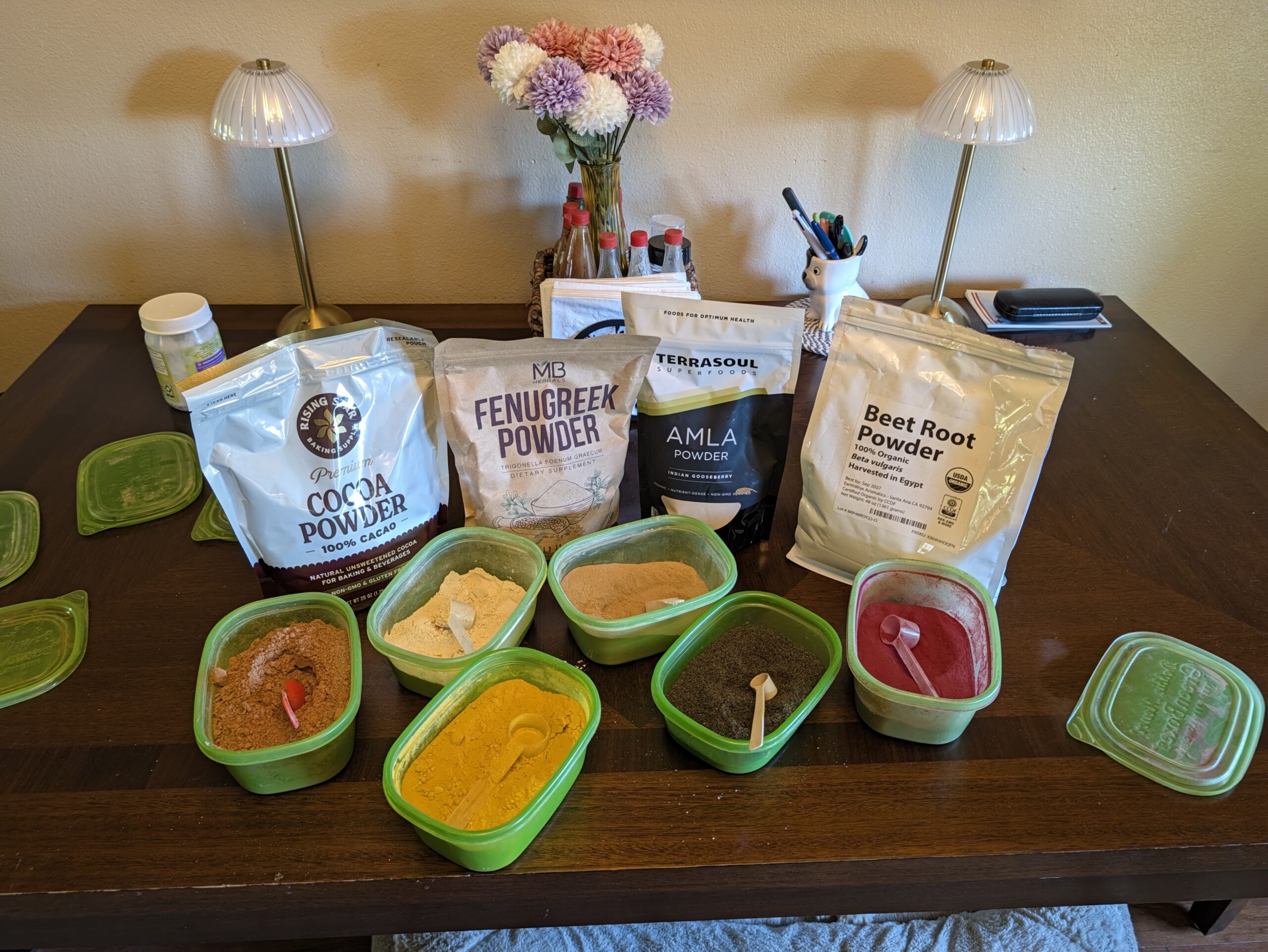
Then I add:
5 grams of creatine
About 1¼ tablespoons of 100% cacao powder
1 tablespoon of a 50/50 ginger and turmeric mixture: I take ginger and turmeric together for a reason: they work better together. The whole is greater than the sum of its parts. I add a little black pepper too, because its piperine dramatically increases the absorption of curcumin from the turmeric.
My dad can’t stand my drink, so he takes turmeric and ginger capsules instead.
Then I add:
1 tablespoon fenugreek powder
1 tablespoon amla powder
1 tablespoon beetroot powder
1 teaspoon black cumin powder
I mix this terrible-tasting cocktail with this little tool, which I absolutely love.
That’s eight different plants in my system by about 5:15 in the morning.
With my morning drink, I also take B12, 2,500 mcg, and kelp, 325 mcg, every other day.
Daily, I also take 500 mg vegan DHA/EPA, and during the winter I take 125 mcg vitamin D.
5:30–6:00 A.M. — The Fruit & Vegetable Plate
Between 5:30 and 6:00, I eat a large plate of fruits and vegetables.
I include some fat with this meal because several vitamins, including A, D, E and K, are fat-soluble, and dietary fat can help with their absorption. And it isn’t just the fat-soluble vitamins. Lycopene—the powerful red pigment in tomatoes and watermelon—is absorbed better when you eat it with some fat. Most people never hear that, which is another reason I like avocado or walnuts with this plate.
Usually that’s half a medium avocado or a palm-sized serving of nuts—preferably unsalted walnuts.
A typical plate includes:
One medium carrot, about five inches of cucumber, ½ cup cranberries, half a bell pepper, a medium tomato, some blackberries or blueberries, raspberries, a couple of orange slices, half a kiwi, and half a pear or peach—or whatever fruit happens to look good and be on sale.
I change it up constantly, but one thing doesn’t change:
I fill a large plate. I eat a lot!
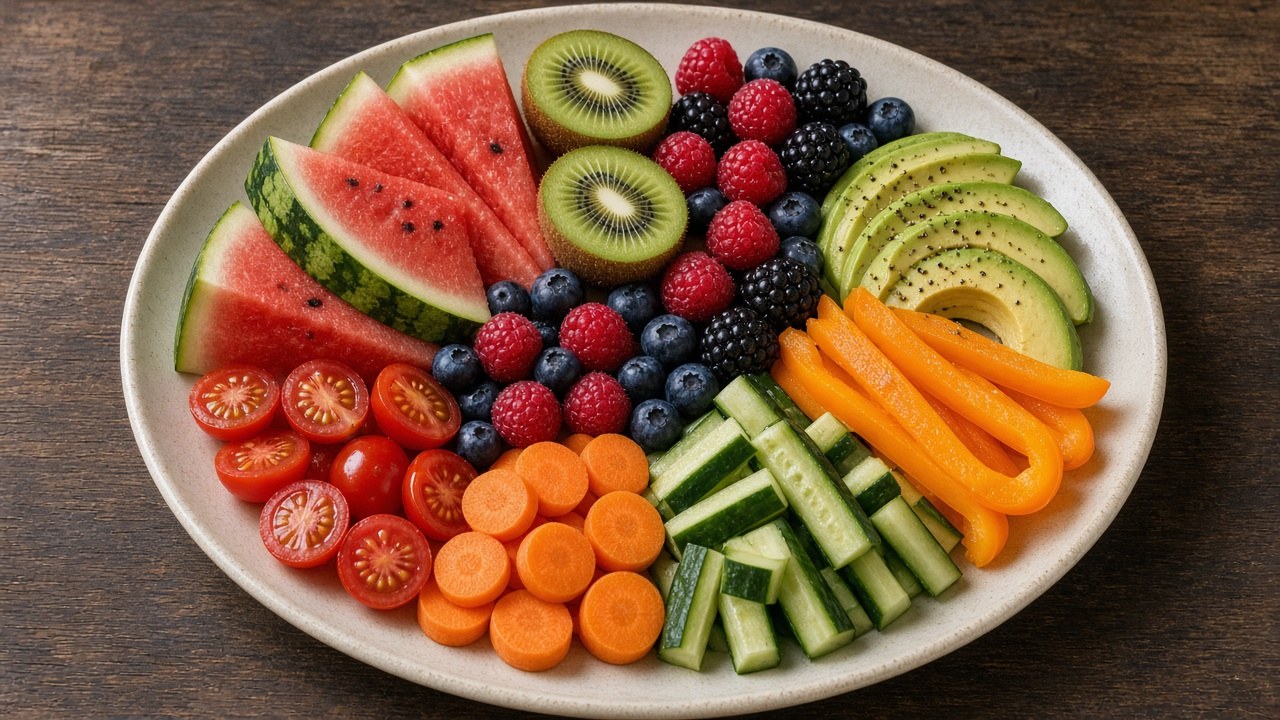
By this point I’m already at roughly 19 different plants for the day—and I haven’t even had breakfast yet.
Variety matters. Your gut microbiome benefits from a diverse diet, and eating this way makes plant diversity almost effortless.
10:00 A.M. — The Monster Breakfast
Breakfast comes at about 10:00 a.m., after my dad and I have walked the dogs in the hills and I’ve exercised.
While exercising, I hydrate with green tea. I like Uncle Lee’s Organic Green Tea.
Then comes breakfast.
And my breakfast is huge.
I eat basically the same breakfast five or six days a week because I absolutely love it.
I make several days of oatmeal at once. I actually prefer it chilled, and I’m also a little lazy. I don’t want to make oatmeal every morning when making three or four days’ worth takes hardly any more effort.
I start with 1 cup steel-cut oats. A lot of people soak them overnight or boil them for 20–30 minutes. My dad likes them almost right out of the package, so I only boil ours for about five minutes.
Then I add:
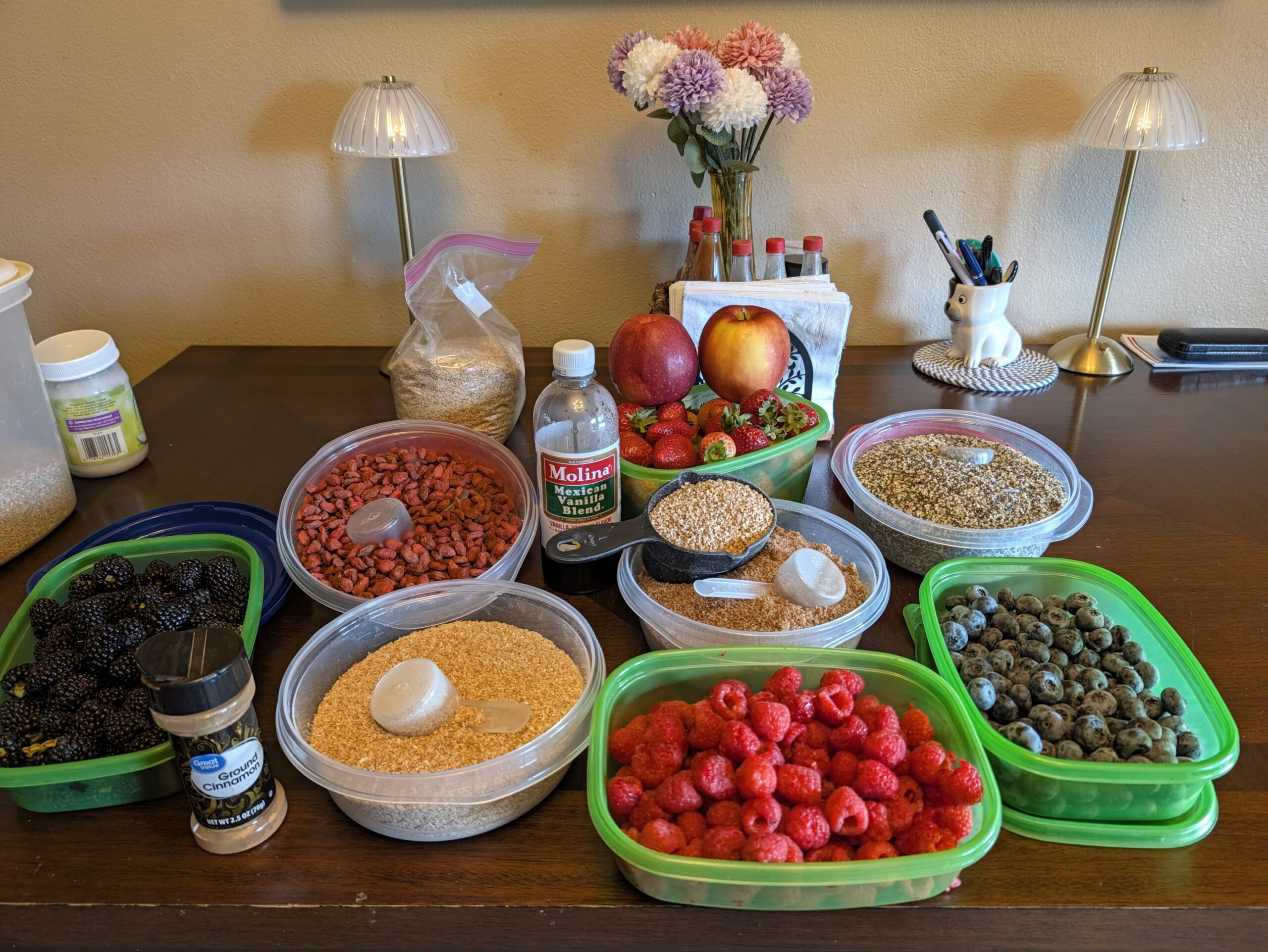
That makes about four Lex-sized servings—or eight normal-person/Dad-sized servings.
Without double-counting berries I’ve already eaten earlier in the day, I’m somewhere around 40 different plants, give or take a few.
And I’m still not done.
The Salad — Where Things Get Ridiculous
This is one of the most important meals I eat.
At least five or six days a week, I eat a huge plate of salad.
There are so many ingredients that I make about three weeks’ worth at a time—in my sink.
Yes, my sink.
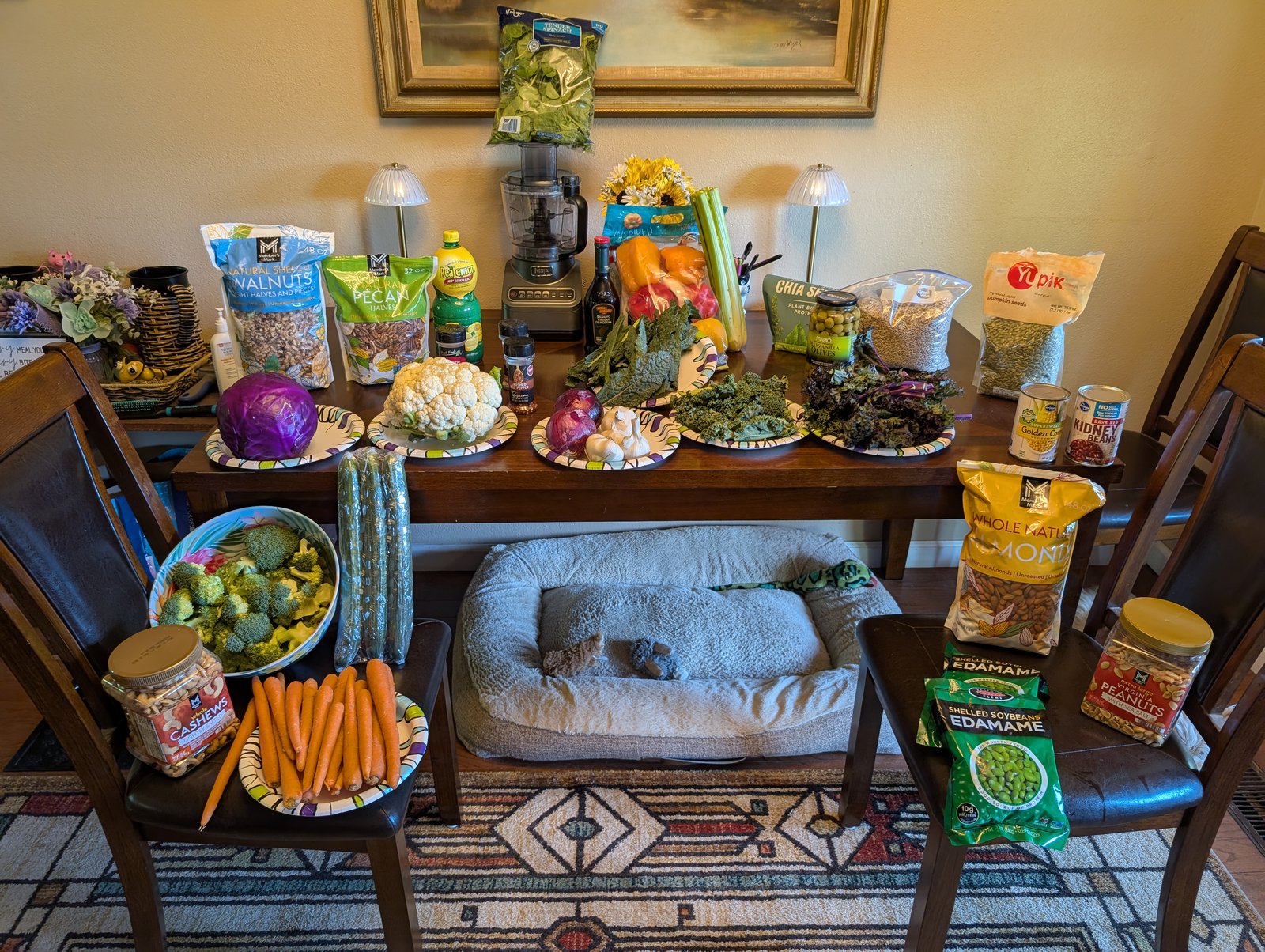
Once everything is chopped and mixed, it goes into Debbie Meyer containers in the refrigerator. Those containers have been fantastic for keeping this enormous batch of salad fresh.
My basic salad usually includes these staples:
Lacinato kale, red kale, curly kale, spinach, romaine, arugula, and—when it’s growing wild around my yard—purslane.
Then cauliflower, broccoli, red cabbage, red onion, several cloves of garlic, peas, edamame, celery, cucumber, yellow squash, zucchini, bell pepper, green olives, black beans, kidney beans, corn and carrots.
Then come the herbs, spices, seeds and nuts:
Red pepper, cayenne, oregano, marjoram, thyme, basil, rosemary, sage, black pepper, sunflower seeds, pumpkin seeds, pecans, peanuts, cashews, walnuts and almonds.
I also finely chop some lemon into it and add lemon juice. I use potassium chloride as my salt substitute.
I don’t mix avocado or tomatoes into the giant batch because they seem to shorten its refrigerator life. I add those after the salad goes onto my plate.
Raisins go on afterward too because Dad doesn’t particularly like them in his salad.
For dressing, I generally use balsamic vinegar or apple cider vinegar.
Sometimes I’ll throw in mango, blueberries or blackberries just to change things up. The exact amounts vary depending on what I have around the house, but those ingredients are my staples.
That’s roughly 42 different plants in the salad alone, give or take a few.
By the time dinner rolls around, I can be around 77 different plants for the day.
My microbiome ought to be throwing me a parade by now.
Dinner — Dad Finally Gets Some Variety
Homemade Oil-Free Hummus
We make our own hummus without oil, usually once or twice a week.
It always contains garbanzo beans and Hatch green chile. In fact, we eat green chile with almost every dinner.
I’ll also add finely chopped onion, cayenne, black pepper and fresh garlic.
This is one of the few dinners we eat that doesn’t contain a mountain of mushrooms.
I eat my hummus on multigrain bread.
Dad prefers sourdough.
Two Gallons of Stir-Fry
We make a lot of stir-fry—and we make about two gallons at a time.
Many of the same vegetables from the salad go into it: lots of celery, bell pepper, spinach, carrots, broccoli and cauliflower.
Into that giant batch goes 18 ounces of mushrooms, usually white button or portobello, several cloves of garlic, and 16 ounces of tofu.
This is one of the rare times we use some oil. For the entire giant batch, I’ll use just a couple tablespoons of Lao Gan Ma spicy chili oil.
And the rice is fantastic.
We don’t use processed white rice. I love Lundberg Regenerative Organic Certified Wild Blend Rice—brown, red and black varieties.
Two Gallons of Spaghetti Sauce
Yep.
Two gallons again.
This is another meal where a little oil and added sugar can sneak in because I use about three bottles of prepared sauce as the base—usually whatever is on sale.
I’m busy. I’m not going to pretend I make absolutely everything from scratch.
But then I load that base with fresh tomatoes, lots of fresh garlic, red onions, spinach, corn, 18 ounces of mushrooms, black beans, celery, Hatch green chili, cayenne, black pepper and yellow squash.
Sometimes broccoli and cauliflower go in too.
We serve it over whole-grain spaghetti.
Dad’s Beans
My dad makes the best beans in the world.
And—you guessed it—we make about two gallons at a time.
He starts with Tia Rita’s Downhome Chili Mix, anywhere from spicy to extra hot. I don’t have an affiliate relationship with them; I just think the stuff is worth knowing about.
He adds Rotel diced tomatoes with green chili, 18 ounces of mushrooms, red onions, lots of fresh garlic and, of course, pinto beans.
I can’t give you exact quantities because Dad makes them, not me, and I never know exactly what they’re going to taste like.
They’re always a little different.
And they’re always good.
Around 100 Different Plants Every Week
Those are our staples.
During the week I’ll rotate additional fruits in—mangoes, pears, peaches, nectarines, plums, cantaloupe, oranges, clementines and whatever else looks good.
There aren’t many vegetables left for me to add.
Dad loves beets and turnips.
I dislike them highly.
He also likes popcorn with nutritional yeast and our salt substitute, and we both eat sweet potatoes during the week.
All told, we probably reach somewhere around 100 different plant foods over the course of a week, and on many days I’m around 80, depending on exactly what I’ve eaten.
We make large batches because it saves an enormous amount of time. We use Mason jars for Dad’s beans and the spaghetti sauce, when they come to a boil I fill the jars and screw the lids down tight, They seem to seal very well, and in years have never had a spoiled meal from them. But I never go over 3 weeks either.
My Day Winds Down Early
We rarely eat a regular meal after 4:00 p.m.
That generally gives me at least a 12-hour overnight fast.
Dad usually goes 15–16 hours.
I can’t wait that long.
At around 5:30 p.m., I have what I call my second shot of cacao:
A little over 1 tablespoon cacao, another 5–7 grams of creatine, and about 14 ounces of soy milk.
Sometimes I’ll add about 5 grams of sugar as my nightly treat. Sometimes I leave the sugar out.
But the cacao, creatine and soy milk stay.
And that second dose of creatine isn’t an accident. It’s there because of what I described earlier: after experimenting on myself, I could tell a significant difference when I added it back into my day.
Based on the research I’ve done, soy milk is my clear choice among plant milks, and it’s what I use. I’ll eventually do a separate deep dive explaining exactly why.
Why So Much Creatine?
This is something I’ve been experimenting with on myself.
Creatine occurs naturally in animal foods such as meat and fish, while plant foods provide essentially none. Since I’m completely plant-based, I don’t have that dietary source.
For a while, after doing a loading phase, I was taking just one 5-gram serving in the morning.
Over the last three to four months, Dad and I have both experimented with the amount of creatine we take. After our initial loading period, I noticed a dramatic drop-off when I stayed with only one 5-gram serving in the morning. Dad noticed a difference too.
So I added a second serving later in the day. Within about a week, I could tell a significant difference—and Dad benefited from the higher intake too. That’s why creatine has become a regular part of both of our routines.
That’s why I currently take roughly 5 grams in the morning and another 5–7 grams later in the day.
I’m not telling every vegan that he or she needs to take the amount I do. I’m telling you what I personally experimented with, what I observed, and what I’m doing now because of it.
And at my age, with the way I train, I’m paying very close attention to anything that appears to help me maintain strength, muscle and performance.
This Is How I Fuel
That’s pretty much how I fuel myself.
It isn’t complicated. It isn’t glamorous.
Some of it tastes terrible.
I buy what’s on sale. I make enormous batches because I’m busy. I repeat foods I love. I eat a ridiculous variety of plants.
And somehow, at my age, while getting leaner, I’m seeing results in the mirror that are surprising even me.
Around 80 different plants in a day. Around 100 over a week.
You want to make your microbiome happy?
Start feeding it plants.
The Unofficial Diet Essential: The Heavy-Duty Air Plunger

“I am recommending this because my colon forced me to.”
Listen, when you’re putting down over 100 grams of fiber a day from whole foods, beans and greens, modern plumbing isn’t always built for the output.
I finally got this POPULO battery-powered air plunger — the 5 Bar electric clog remover with a built-in pump — just to keep the pipes clear. Price moves on Amazon, so check the listing.
So if you decide to start eating the way I do, consider this a tactical necessity.
You’ve been warned.
See the Science
Why I build my meals this way. The daily plate stays here. The research notes live on a companion page — empty stubs for now, filled as I go. No invented claims.