
Benefits of the Heavy Bag
Short bursts. Real impact. Why my dad and I hit the bag every single day.
Why The Heavy Bag Works
Most people train once a day. I train three to five times a day in short, explosive bursts of two to five minutes. Those micro-doses are the point.
Short, Frequent Bursts Beat One Long Workout
Neuroplasticity is not about intensity alone — it is about repetition and frequency. Short, frequent, high-intensity neuromuscular bursts create more brain rewiring than one long session. That is why boxing-style training shows up in Parkinson’s therapy, stroke rehab, athletics, and cognitive training.
About 90 Minutes After A Meal
About ninety minutes after a meal, the sugar from that meal is usually circulating in the blood. Hitting the bag then lets working muscle pull glucose out of the bloodstream — which blunts the insulin spike — and can also reduce the triglyceride rise that follows a meal. That is when I hit it.
Blood Flow, Clarity, And The Calm After
Punching plus footwork raises heart rate, oxygen delivery, and cerebral blood flow. Then you drop into deep breaths. That swing — explosive to calm — is the fastest way I know to kill stress. My head is clearer after a round than before it.
Footwork Lights Up The Whole Brain
Punching while moving your feet demands timing, rhythm, spatial awareness, bilateral coordination, and rapid motor planning. Cerebellum, motor cortex, basal ganglia, prefrontal cortex — you are building new pathways every round.
Bone Responds To Frequency, Not Duration
Bone responds more to frequent small impacts than to one big workout. Every punch loads the forearm, wrist, humerus, shoulder, spine, and legs. Doing that many times a day is exactly how bone responds best — and how you keep balance and reaction time sharp.
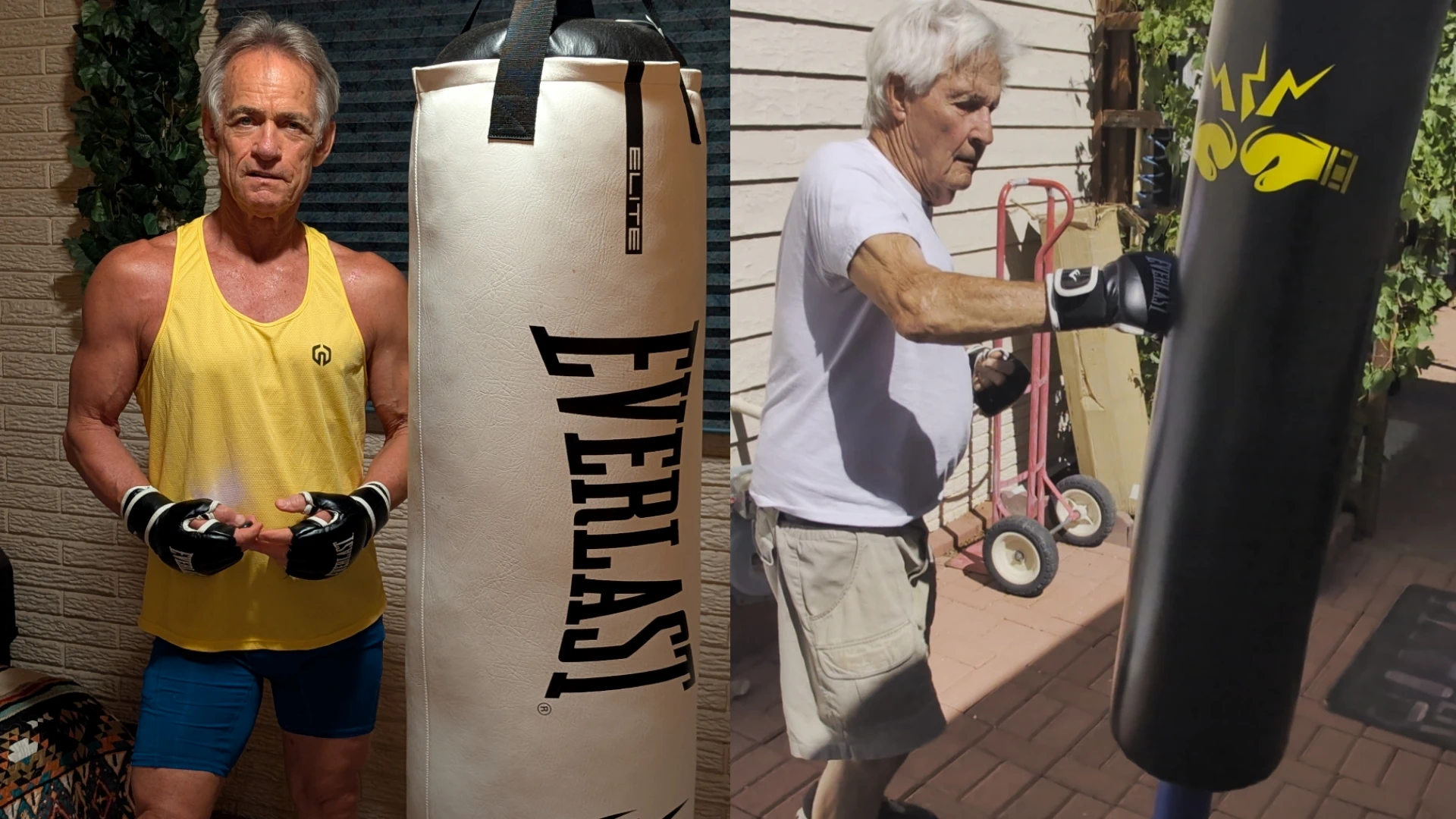
My 88-Year-Old Father On The Bag
Punching a bag is not just hitting. It is legs, hips, core, shoulders, arms, back, balance, and coordination working as one unit. For my dad that means better stability, posture, joint control, and confidence — the stuff that keeps a person independent.
It loads bone safely. It sharpens fall-prevention skills: lateral movement, weight shifting, hip rotation, core bracing, ankle stability. It lifts his mood. And it gave him purpose. Purpose is medicine.
Start slow. Light taps, slow combinations, gentle footwork, ten to twenty seconds at a time. You do not need power — you need movement. And check with a qualified healthcare professional before starting anything new.
FOOSH: Why Wrists Matter
When people fall and break a hip, a large percentage break a wrist too. In the ER that mechanism has a name: FOOSH — Fall On Outstretched Hand. The survival reflex throws the arms out. If the skeleton has been hollowed out by a poor diet and a sedentary life, those bones snap.
Breaking a hip and a wrist together eradicates independence — no walker, no crutches, no pushing up from a chair. That is why I take the bag so seriously. Every punch micro-loads the chain that takes the brunt of a fall: knuckles through wrists, up the radius and ulna, into the shoulder. Dense shock absorbers instead of fragile glass.
Most people my age sit after meals and slowly hand back their coordination, bone density, reaction time, and balance. I do the opposite. Train like a fighter, but in micro-doses. I am not imagining the benefits — I am living them.
Get On The Bag
See the full Forge setup, glove reviews, and the bags we actually use — or grab gear and start.