But Where Do You Get Your Protein?
If I had a dollar for every time somebody asked me that question, I could probably retire again.
Now they’re even putting protein in soda! My God, you’d think America was suffering from a nationwide protein deficiency.
I’m a two-time drug-free Lightweight Mr. Mid USA bodybuilding champion. I’ve been eating a whole-food, plant-based diet for almost 14 years. My father is almost 89, and he’s downstairs working out at 4:00 every morning. Neither of us eats meat.
So perhaps we’re asking the wrong question. Instead of asking where I get my protein, maybe we should be asking where we ought to get our protein.
The Gorilla and the Panther
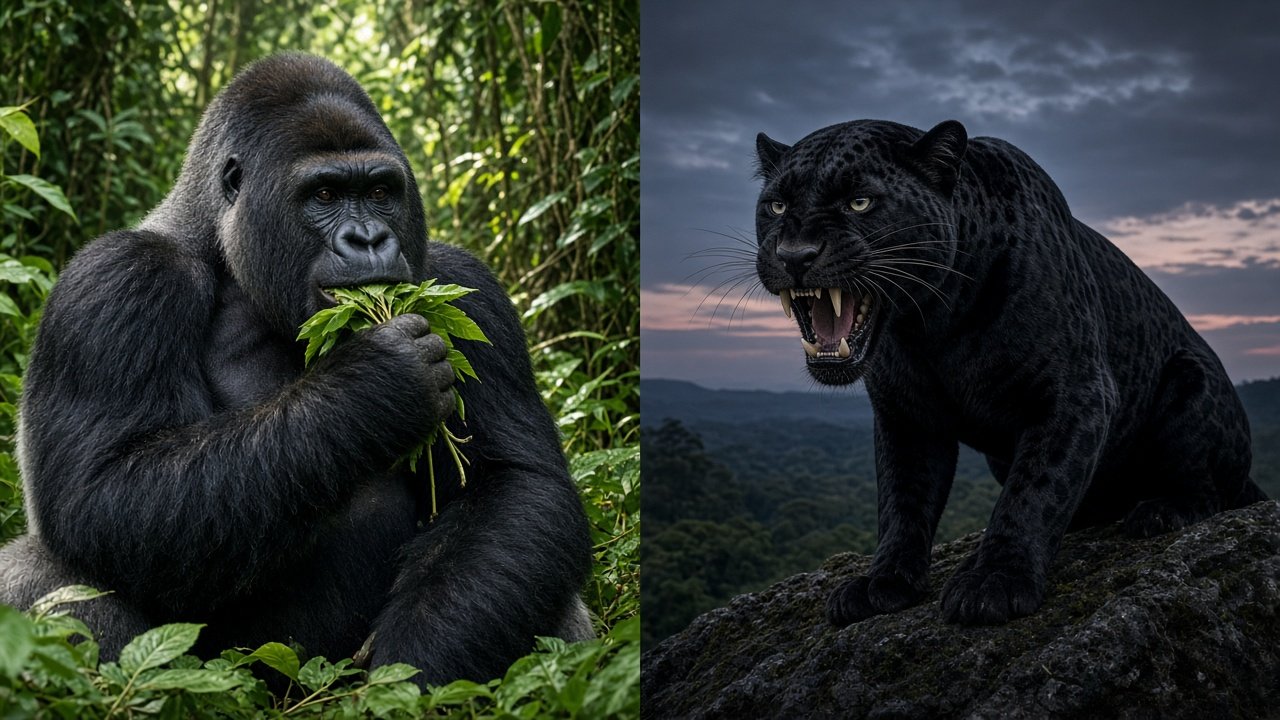
A panther’s back teeth are scissors, built to slice meat. A gorilla has flat, grinding molars, like ours. Its gut is a bit bigger than ours because it lives on leaves, stems and bark, not broccoli, beans and spinach.
We’re not gorillas. But we’re built far more like them than like a panther.
When leaves made up most of their diet, wild mountain gorillas ate protein at levels close to the maximum recommended for humans, about what you’d see on a high-protein weight-loss diet.
A gorilla has never walked into a grocery store and bought a bag of lentils, a can of chickpeas or a container of hummus. And I’ve never seen one worrying about where to buy its next protein shake.
We’ve got it easy: lentils, chickpeas, edamame, tofu, hummus, beans and whole grains.
What Happened When Zoos Changed the Gorillas’ Diets
Wild gorillas eat high-fiber, low-calorie plants all day. Many zoo gorillas got calorie-dense biscuits instead, loaded with starch and sugar. In zoos, heart disease is the leading cause of death in adult male gorillas.
So three U.S. zoos, including Cleveland’s, pulled the biscuits and cut back the fruit. Two of them also added a resistant-starch fiber supplement.
Small, early studies, and the researchers say so. But the direction is hard to miss.
How Much Protein Do We Actually Need?
Most Americans already blow past the RDA. And in 71,751 adults eating the same 2,000 calories, vegans averaged about 72 grams of protein a day. Meat eaters? About 76.
Can Too Much Protein Actually Hurt You?
America is obsessed with getting more protein. But how often do we stop and ask what happens when we eat too much, especially from animal sources?
Protein is essential. But more is not automatically better, and the source matters.
I’m interested in building muscle, maintaining my strength and enjoying my life for decades to come. I don’t want to sacrifice my long-term health in pursuit of another inch on my biceps.
We’re training for longevity, not just the next bodybuilding contest.
Don’t take my word for it. Read the research. Verify it with your favorite AI.
The Complete Protein Myth
You’ve heard plant protein is “incomplete.” Wrong. Plant proteins carry all nine essential amino acids. Some are lower in one or two, like grains in lysine, but eat a mix of beans, grains, nuts and seeds over the day and you’re covered. No combining foods at every meal. Researchers call “complete” and “incomplete” misleading.
The one truly incomplete protein in the food supply? Gelatin. Jell-O.
Can You Build Muscle Without Meat?
Thirty-four active adults, average age 72, ate a well-planned vegan diet for 10 days and a meat-containing diet for 10 days, with the same calories and protein. Daily muscle building: 1.23% vegan, 1.29% omnivore. No significant difference.
In a 2026 trial, 72 adults 65 and older who switched to a vegan diet on their own, with no plan, ate 19 to 28 fewer grams of protein a day. In 12 weeks they lost thigh muscle (0.61 liters) and lean mass (1.15 kg). The group that also did resistance training lost less (0.35 liters, 0.62 kg).
The lesson: plan your protein and lift. Beans, lentils and soy every day. That’s exactly what Dad and I do.
Does Your Protein Source Affect Longevity?
These are observational studies: strong links, not proof. A Harvard study of 131,342 health professionals pointed the same way, but only in people with at least one unhealthy habit like smoking, heavy drinking, excess weight or inactivity. We are always seeking the truth.
Where Dad and I Get Our Protein
I’m not a doctor. We take zero prescriptions. I’m not anti-medicine. I’m pro-health. Some prescriptions save lives, like antibiotics for an infection. If you go plant-based, keep up with your blood work. That way your doctor can safely reduce your medications or take you off them altogether.
Verify It With Your Favorite AI
Every number on this page comes from a study listed below. Copy any link below into ChatGPT, Grok or Gemini and ask:
I view NutritionFacts.org, and Dr. Michael Greger is the main person I follow.
Show all 26 sources
- Institute of Medicine. Dietary Reference Intakes for Energy, Carbohydrate, Fiber, Fat, Fatty Acids, Cholesterol, Protein, and Amino Acids. National Academies Press, 2005.
- Bauer J et al. Evidence-based recommendations for optimal dietary protein intake in older people (PROT-AGE). J Am Med Dir Assoc, 2013.
- Morton RW et al. Protein supplementation and resistance training-induced gains in muscle mass and strength: meta-analysis. Br J Sports Med, 2018.
- Berryman CE et al. Protein intake trends and conformity with the Dietary Reference Intakes in the United States. Am J Clin Nutr, 2018.
- Rizzo NS et al. Nutrient profiles of vegetarian and nonvegetarian dietary patterns. J Acad Nutr Diet, 2013.
- Rothman JM et al. Nutritional geometry: gorillas prioritize non-protein energy while consuming surplus protein. Biol Lett, 2011.
- Rothman JM et al. Decaying wood is a sodium source for mountain gorillas. Biol Lett, 2006.
- Chivers DJ, Hladik CM. Morphology of the gastrointestinal tract in primates: comparisons with other mammals in relation to diet. J Morphol, 1980.
- Less EH et al. Implementing a low-starch biscuit-free diet in zoo gorillas: the impact on health. Zoo Biol, 2014.
- Less EH et al. Implementing a low-starch biscuit-free diet in zoo gorillas: the impact on behavior. Zoo Biol, 2014.
- Mariotti F, Gardner CD. Dietary protein and amino acids in vegetarian diets: a review. Nutrients, 2019.
- Greger M. The Protein-Combining Myth. NutritionFacts.org.
- Domić J et al. A well-balanced vegan diet does not compromise daily mixed muscle protein synthesis rates when compared with an omnivorous diet in active older adults. J Nutr, 2025.
- Hevia-Larraín V et al. High-protein plant-based diet versus a protein-matched omnivorous diet to support resistance training adaptations. Sports Med, 2021.
- Monteyne AJ et al. Vegan and omnivorous high protein diets support comparable daily myofibrillar protein synthesis rates and skeletal muscle hypertrophy in young adults. J Nutr, 2023.
- Askow AT et al. Impact of vegan diets on resistance exercise-mediated myofibrillar protein synthesis in healthy young males and females. Med Sci Sports Exerc, 2025.
- Domić J et al. A self-selected vegan diet reduces skeletal muscle mass in healthy older adults: a randomized controlled trial. Am J Clin Nutr, 2026.
- Huang J et al. Association between plant and animal protein intake and overall and cause-specific mortality. JAMA Intern Med, 2020.
- Song M et al. Association of animal and plant protein intake with all-cause and cause-specific mortality. JAMA Intern Med, 2016.
- Allen NE et al. The associations of diet with serum IGF-I and its main binding proteins in 292 women meat-eaters, vegetarians, and vegans. Cancer Epidemiol Biomarkers Prev, 2002.
- Knuppel A et al. Circulating IGF-I concentrations and risk of 30 cancers: prospective analyses in UK Biobank. Cancer Res, 2020.
- Lew QJ et al. Red meat intake and risk of ESRD. J Am Soc Nephrol, 2017.
- Kidney Disease: Improving Global Outcomes (KDIGO) CKD Work Group. Executive summary of the KDIGO 2024 Clinical Practice Guideline for the Evaluation and Management of Chronic Kidney Disease. Kidney Int, 2024.
- Barrantes-Espinola G et al. Isocaloric substitution of animal protein with plant protein and its impact on all-cause, cardiovascular, and cancer mortality: a systematic review and meta-analysis. Clin Nutr, 2026.
- International Agency for Research on Cancer. IARC Monographs evaluate consumption of red meat and processed meat (Press Release No. 240). 2015. See also Bouvard V et al., Lancet Oncol, 2015 and the WHO Q&A.
- National Research Council. Recommended Dietary Allowances, 10th ed.: Protein and Amino Acids. National Academies Press, 1989.